
About a Mermaid caught in Holland.
The Mermaid of Holland, also known as the Greene Wife, the Purmer-seawoman, the Mermaid of Edam or the Mermaid of Haarlem has been floundering through Dutch cultural history for six hundred years. Much has been written about her over the centuries. The original story was written in Latin. People spoke here of an ‘indomita mulier’, loosely translated a fairytale-like woman without a fixed place of residence or abode. What exactly it was therefore remains unclear.
The Late Middle Ages: The Origin of the Story.
The first writer was a monk at the court of Count William VI, father of the famous Countess Jacoba van Beieren. This was followed by the abbot of the Haarlem Karmelieter monastery Joannes Gerbrandis a Leydis and many more writers would follow: historians, physicists, philosophers, doctors and pastors.
In 1517 the story was first translated into Dutch and appeared in the Divisional Chronicle. A chronicle of Holland in the Middle Ages written by Cornelis Aurelius Goudanus, an Augustinian monk who was friends with Erasmus.
The mermaid myth in the seventeenth century.
In the seventeenth century, the story really came out: many literate gentlemen wrote about her. Among them Joost van den Vondel and Jacob Cats and one knew better than the other. At this time scientists added to the ‘Naturalis Historiae’ an extensive treatise about the fact that a real mermaid had been captured in Holland in 1403. The story went far beyond our borders. This while at the same time a local version of the story was circulating which spoke of the Green Wife or the Purmer Seawoman.
‘From a mermaid caught in Hollandt’ is the headline above this story. The engraving also contains the letters meermyn (mermaid) and zeewijf seaman, so there is no doubt that this is a real mermaid.
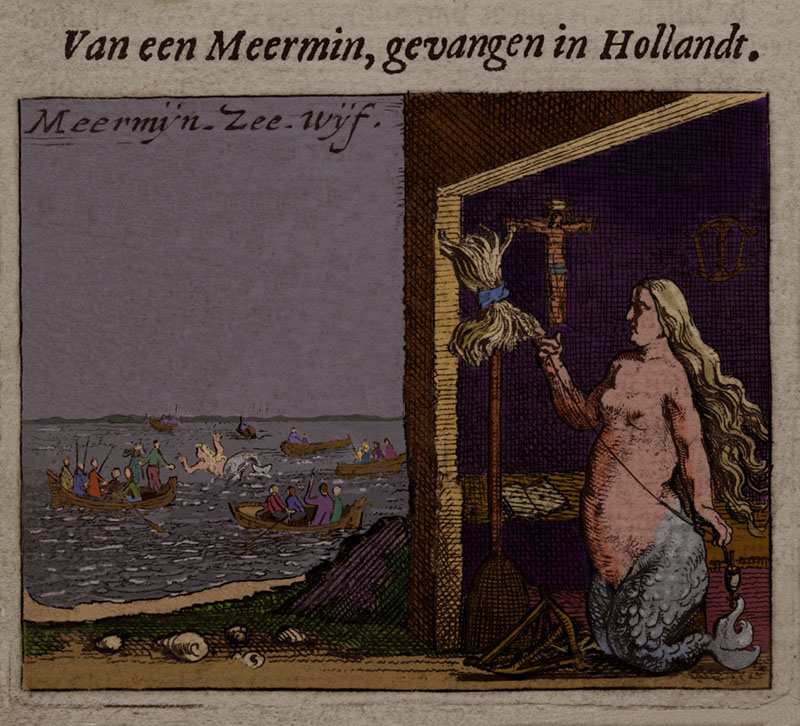
Engraving from Pliny’s Naturalis Historiae. Colored version by Hubert Christiaan Knispel
Enkhuizer Almanac
Nowadays, the story of the mermaid is hardly known, but throughout the eighteenth century, for about a hundred years, a chronicle was included in the back of the (Founders) Enkhuizer Almanac and the date 1403 enclosed the capture of this mermaid. There were only two images in the chronicle. One of the governor and one of the mermaid.
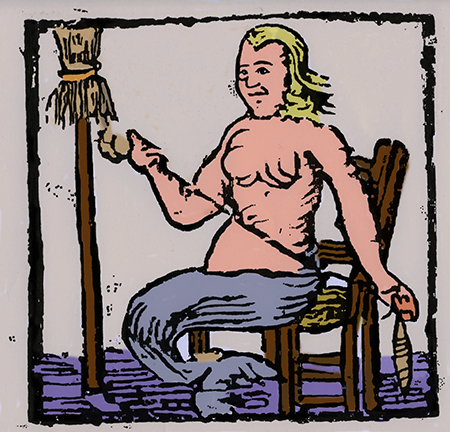
Meermin from the Schoorlder chronicle. Colored version by Hubert Christiaan Knispel.
Over the borders.
The French physicist Jean Baptiste Robinet cited this story in his book “La Nature” as proof of the existence of mermaids. The story also became known in America through the book ‘Tales told in Holland’ written by Olive Beaupré Miller around 1926. Many Americans will have known that book in their childhood. But there is also a story from Germany ‘Das Meerminneke.’ and there are many more.
High time for natural history research (late 18th century).
This mermaid is the only mermaid that has undergone serious natural history research. At this time, people sincerely believed in these kinds of sea creatures and this sea woman really needed to be clarified. The most important researcher was Aernout Vosmaer (1720 – 1799), a famous naturalist, director of the cabinet of stadtholder Willem V and administrator of the first zoo in the Netherlands, the Kleine Loo near The Hague. In his treatises he unravels the story and casts doubt on the authenticity of the catch, after which it becomes a legend and is henceforth seen as a folk tale.